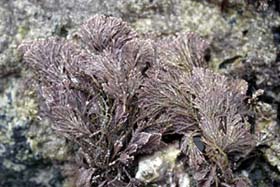
Many claims have been made for the effectiveness of seaweeds on human health. It has been suggested, amongst other things, that seaweeds have curative powers for tuberculosis, arthritis, colds and influenza, worm infestations, and may even improve one´s attractiveness to the opposite sex.
Digenea (Ceramiales, Rhodophycota) produces an effective vermifuge (kainic acid). Laminaria and Sargassum species have been used in China for the treatment of cancer. Inhibition of cancerous tumours in animals seems to be caused by long-chained polysaccharides. Dry Laminaria stipes have long been used in obstetrics to dilate the cervix and were known as "Laminaria tents" (Stein & Borden, 1984), the dry stipe slowly takes up water and expands, such stipes are used in China for the insertion of intrauterine devices. Aqueous extracts from two red algae belonging to the Dumontiaceae have been found to inhibit the herpes simplex virus but no tests have been carried out on humans. Another red alga (Ptilota) produces a protein (a lectin) which preferentially agglutinates human B-type erythrocytes in vitro. Extracts of Ptilota are being marketed. Many of the reported medicinal effects of marine algae have not been substantiated. Corallina (above) has been used in bone-replacement therapy.
Reference
J.R. Stein and C.A. Borden (1984). Causative and beneficial algae in human disease conditions: a review. Phycologia 23:485-501.